
 EN
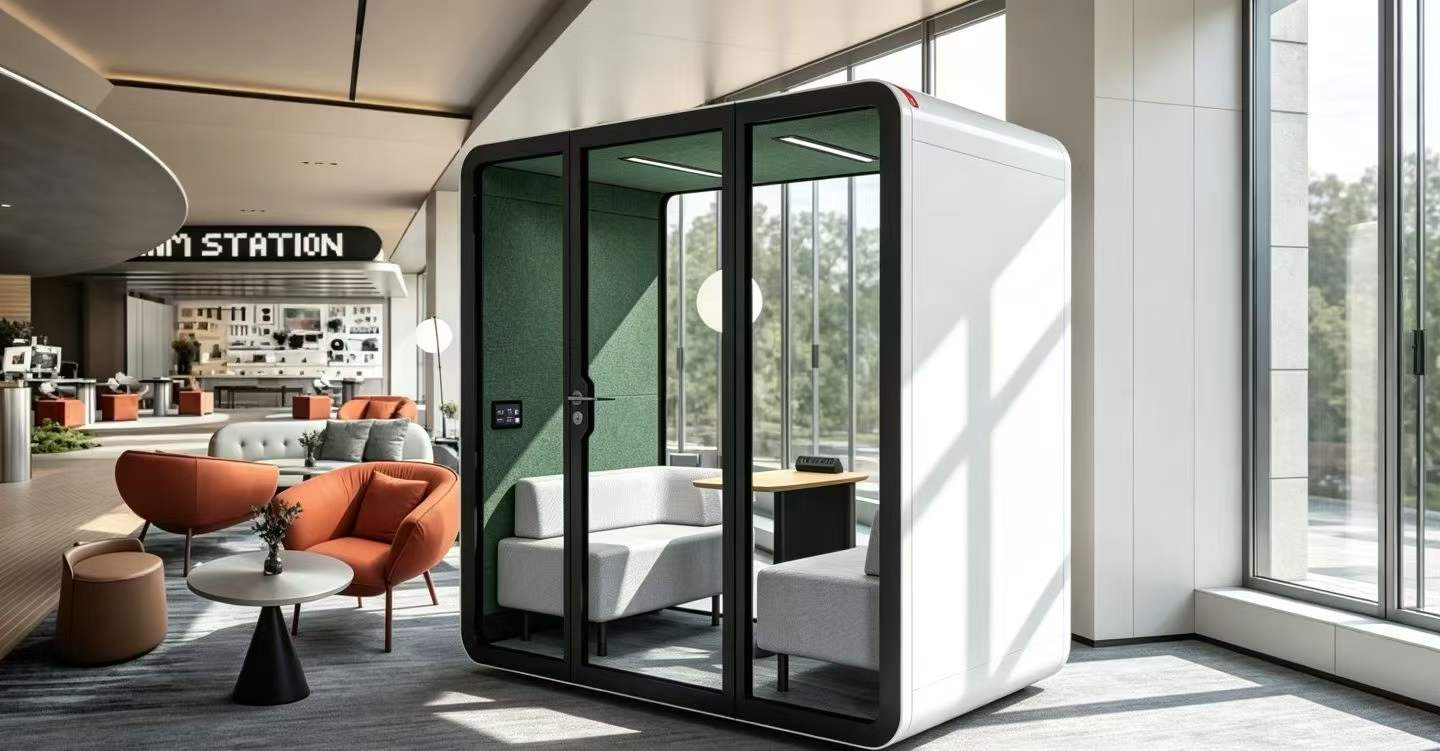
Against the backdrop of the prevalence of hybrid work and open-plan spaces, data from an industry research institute gives much food for thought: employees in open offices get distracted on average every 11 minutes, and it takes more than 23 minutes to regain a state of deep focus. It is exactly this pain point that makes soundproof booths the top choice for efficient work. From the headquarters of tech giants to co-working spaces for startup teams, modular soundproof booths are quietly reshaping the acoustic logic of modern offices with an annual market growth rate exceeding 30%. They are no longer a "quiet privilege" for a select few, but infrastructure for enterprises to boost workforce productivity and retain talent.
## I. Why soundproof booths have become the top choice for efficient work: The efficiency ledger behind the data
To understand the trend that soundproof booths are the preferred option for efficient work, it helps to first work out an efficiency calculation. According to JLL’s *Global Office Trends Report 2024*, among enterprises that have adopted modular soundproof pods, employees reported an average 42% increase in focused work time and a 28% rise in meeting efficiency scores. Another case analyzed by Harvard Business Review shows that after an internet company installed 12 soundproof booths in its R&D area, the iteration and delivery cycle of its core development team was shortened by roughly 15%.
These figures point to a straightforward conclusion: noise distraction represents a hidden cost of knowledge work. Through physical partitions and acoustic treatment, soundproof booths turn "controllable quiet" into a quantifiable and reusable office resource. When enterprises start measuring space value by "output per focused hour" instead of "workstations per square meter", the preference for soundproof booths for efficient work gains solid financial rationale.
## II. Trend seen from product capability: How soundproof booths balance "quietness" and "flexibility"
Soundproof booths rising as the top pick for efficient work stems from continuous product upgrades. Early soundproof pods were bulky, stuffy and poorly ventilated, while today’s modular soundproof booths have evolved with several key capabilities:
Standardized acoustic performance: Mainstream products can reduce noise by 30–35 decibels, equivalent to bringing the volume of normal conversation down to the level of page-turning in a library. Double-layer insulating glass and damping sealing strips deliver "instant quiet upon closing the door".
Plug-and-play flexibility: No civil construction is required; assembly can be finished within 2 to 4 hours, and units can be relocated and reconfigured as teams expand. This is particularly suitable for businesses with short lease terms and frequent workstation adjustments.
Fresh air and smart integration: Built-in silent fresh air systems keep CO₂ concentration below 1000 ppm. Combined with reservation systems and occupancy indicator lights, they prevent management issues such as soundproof booths being occupied solely for personal calls.
Case evidence: A cross-border e-commerce company fitted eight four-person soundproof booths within its 3,000-square-meter open office area for cross-timezone video conferences and financial reconciliation. Three months later, statistics from the administration department showed complaints about meeting room resource conflicts dropped by 67%, while the average daily utilization rate of the soundproof booths reached 81%. Soundproof booths earn their reputation as the first choice for efficient work not from marketing concepts, but from frequent real-world usage.
## III. Selection guide to avoid pitfalls: Making soundproof booths truly serve efficient work
Despite the clear trend, soundproof booths can only deliver efficient office benefits if the right products are chosen. Drawing on industry reports and user feedback, three dimensions are recommended for evaluation:
Check test reports rather than promotional claims: Ask suppliers for third-party acoustic test data, focusing on sound insulation performance across the 125Hz–4000Hz frequency band, instead of relying on marketing slogans citing a single "XX decibel noise reduction".
Calculate full-lifecycle costs: Beyond purchase prices, assess relocation wear and tear, filter replacement frequency and power consumption. A co-working operator’s comparison found that demountable soundproof booths have around 35% lower five-year overall costs than traditional partitioned meeting rooms.
Match the space scenario instead of blindly opting for larger sizes: Single-person focus pods suit phone calls and deep writing, while 2–4 person pods are designed for quick discussions. After a consulting firm deployed booths at a ratio of "1 single-person pod for every 15 workstations", employee satisfaction improved markedly and space waste was avoided.
## Closing Remarks
As "focus" becomes a scarce resource, competition among office spaces essentially boils down to the capacity to protect attention spans. Soundproof booths becoming the preferred choice for efficient work reflects enterprises’ respect for employees’ cognitive load as well as a rational decision for refined operations. From noise reduction metrics and utilization statistics to flexible deployment and full-lifecycle costs, this industry segment is answering a simple question with verifiable value: when spaces meant to be quiet stay quiet, efficiency speaks for itself. For teams still on the fence, soundproof booths may need to be moved from the "optional" to the "essential" list in the next office renovation plan.